Metal Roof Installation in DeLand & Volusia County, FL
Built to Last.
Metal roofing has become one of the most requested upgrades in Central Florida, and for good reason: it shrugs off the sun, sheds wind-driven rain, and keeps protecting your home decades after an asphalt roof would have been replaced. Heritage Roofing & Repairs has installed metal roofs across DeLand and Volusia County since 2010.
As a licensed and insured Florida roofing contractor (license CCC1333379), we install metal systems to the Florida Building Code's wind requirements and back every installation with a 5-year workmanship warranty in addition to the manufacturer's finish and material warranties.
- Licensed and insured Florida contractor — CCC1333379
- Standing seam and exposed-fastener systems
- Installed to Florida Building Code wind requirements
- 5-year workmanship warranty on every metal roof
How long does a metal roof last in Florida?
A properly installed metal roof typically lasts 40–70 years in Florida, compared with 15–30 years for asphalt shingles in our heat and UV. For many Volusia County homeowners, a metal roof is the last roof they will ever buy — and it keeps performing through summer storms that age other materials quickly.
That longevity comes from the material itself: metal does not dry out, curl, or shed granules the way asphalt does under Florida sun. Factory-applied finishes resist fading and chalking for decades, and the panels themselves resist rot, insects, and mildew entirely.
The honest trade-off is upfront cost. A metal roof costs more to install than shingles, but when you divide the price by decades of service — and factor in fewer replacements, less maintenance, and potential insurance credits — the lifetime math often favors metal.
What types of metal roofing do we install?
We install standing seam panels with concealed fasteners — the premium option for homes — and classic exposed-fastener panels such as 5V crimp, a longtime Florida favorite. Panel material is typically coated steel, with aluminum recommended near the coast for its resistance to salt corrosion.
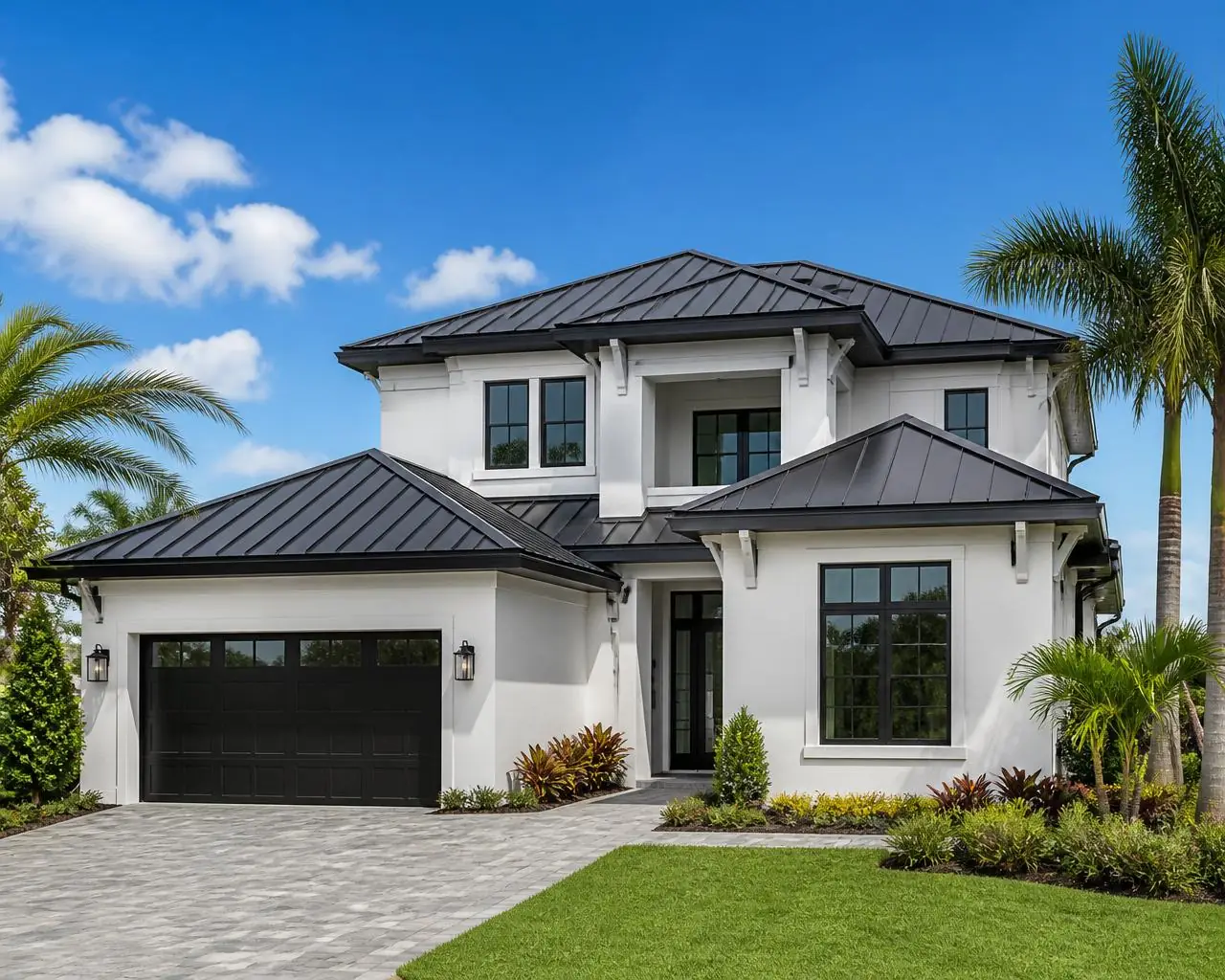
Each system comes in a wide range of factory finishes, from traditional silver to modern matte black like the roofs you see on new custom homes around DeLand.
Standing seam
Concealed fasteners, clean vertical lines, and the best long-term weather-tightness — no exposed screws to age
5V crimp and exposed-fastener panels
The classic Florida metal roof look at a lower cost, with gasketed screws that should be checked over time
Aluminum panels
The right choice near Daytona Beach and Ormond Beach, where salt air corrodes standard steel faster
Coated steel (Galvalume)
Excellent strength and corrosion resistance for inland homes in DeLand and Deltona
Do metal roofs hold up in hurricanes?
Yes — metal is among the best-performing roofing materials in high wind. Panels are tested and approved for the Florida Building Code's wind requirements, and standing seam systems mechanically lock to the structure with concealed clips rather than relying on adhesive seal strips the way shingles do.
Volusia County is not in the High-Velocity Hurricane Zone — that designation covers Miami-Dade and Broward — but local code wind requirements are still demanding, and every panel profile we install carries the required Florida product approvals for its tested wind rating.
Just as important is what is under the panels: a fully sealed underlayment over inspected decking, correct clip and fastener spacing, and properly detailed ridge, eave, and valley flashings. Wind failures almost always start at poorly executed details, not in the field of the roof.
Do metal roofs keep your home cooler in Florida?
Yes. Metal panels with reflective finishes bounce a large share of the sun's radiant heat away from the home instead of absorbing it the way dark asphalt shingles do. Combined with proper attic ventilation, that can noticeably reduce the load on your air conditioning during Central Florida summers.
Many panel finishes are formulated as "cool roof" coatings that reflect solar energy even in darker colors. Metal also cools off quickly after sunset rather than radiating stored heat into the attic all evening.
Comparing options? See how metal stacks up against our shingle roofing service, or read about the full roof replacement process.
Wondering if metal is right for your home?
Get a free inspection and an honest side-by-side comparison of metal and shingle options for your house — real numbers, no pressure.
What is the process for installing a metal roof?
The process mirrors any quality re-roof: free inspection, written estimate, permit — Florida requires a permit for roof replacement — tear-off, decking repairs, sealed underlayment, then panel installation with the correct clips, fasteners, and trim. Most homes take a few days longer than a shingle roof because panels are cut and detailed to fit.
1. Free inspection and estimate
Roof measurement, decking assessment, and a line-item price
2. Panel and finish selection
Profile, gauge, material, and color chosen for your home and location
3. Permit and scheduling
We pull the building permit and schedule county inspections
4. Tear-off and dry-in
Old roofing removed, decking repaired, high-temp underlayment sealed
5. Panel installation
Panels, flashings, and trim installed to code and manufacturer spec
6. Final inspection and cleanup
County sign-off, magnetic sweep, and a walkthrough with you
What warranties and insurance benefits come with metal?
Metal roofs carry long manufacturer warranties on the panel material and factory finish, plus our 5-year workmanship warranty on the installation. Documented wind-mitigation features on a new metal roof can also qualify Volusia County homeowners for premium credits on their windstorm insurance.
After installation we provide the documentation your wind-mitigation inspector needs. If a storm ever does damage the roof, metal damage tends to be visible and well-defined, which makes insurance claims more straightforward to document.
Where do we install metal roofs?
From our home base in DeLand, we install metal roofing throughout Volusia County — including coastal homes where aluminum panels earn their keep:
Metal Roofing FAQs
Are metal roofs loud when it rains?
Not on a home. Residential metal roofs are installed over solid decking and underlayment — often over your existing attic insulation as well — so rain sounds much like it does on any other roof. The "loud tin roof" reputation comes from open-frame barns and sheds with nothing under the panels.
Can you install a metal roof over my existing shingles?
Florida code allows a metal-over-shingle recover only in limited circumstances, and we usually recommend against it. A full tear-off lets us inspect and repair the decking, install a sealed underlayment, and give you a roof we can honestly warranty. We will tell you plainly if your roof is a candidate for either approach.
Do metal roofs attract lightning?
No. Lightning strikes the tallest object in an area regardless of material, and a metal roof does not increase the odds of a strike. If anything, metal is noncombustible, which makes it one of the safer roofing materials in a lightning-prone state like Florida.
How much more does metal cost than shingles?
Metal typically costs noticeably more upfront than an architectural shingle roof of the same size — the exact difference depends on panel profile, material, and roof complexity. Because metal lasts 40–70 years versus 15–30 for shingles in Florida, many homeowners come out ahead over the life of the home. Your free estimate shows both numbers side by side.
Ready for a Roof That Lasts Decades?
Hurricane-rated metal, installed right the first time.
386-848-9122heritageroofingandrepairs@yahoo.com