Materials
Metal vs. Shingle Roofs in Florida: Cost, Lifespan & Hurricane Performance
How do metal and shingle roofs compare at a glance?
Here is the side-by-side view we walk Volusia County homeowners through before they choose. Every line below gets its own section in this guide.
| Metal Roof | Asphalt Shingle Roof | |
|---|---|---|
| Upfront cost (typical Volusia home) | Commonly 1.5–2.5x the price of shingles | Commonly $9,000–$18,000 installed |
| Typical lifespan in Florida | 40–70 years | 15–30 years (often 15–20 in Florida heat) |
| Hurricane wind performance | Excellent when installed to code; panels tested for high wind uplift | Good; premium shingles carry ASTM D7158 Class H (150 mph) ratings |
| Maintenance | Low; periodic fastener checks on exposed-fastener panels | Moderate; sealant, shingle repairs, algae cleaning |
| Energy efficiency | Reflective finishes shed heat and cut cooling load | Absorbs more heat; lighter “cool” colors help |
| Resale story | Long remaining life and premium curb appeal | Standard; value depends heavily on roof age |
Which costs less up front — and over the roof's life?
Up front, shingles win and it isn't close. An architectural shingle roof replacement on a typical Volusia County home commonly lands between $9,000 and $18,000 in 2026, while a comparable metal roof typically runs 1.5 to 2.5 times that — exposed-fastener panels at the low end, standing seam at the high end. We break the shingle numbers down fully in our Volusia County roof cost guide.
Over the roof's life, the math flips. As an illustration: a $14,000 shingle roof that lasts 18 Florida years costs roughly $780 per year. A $28,000 standing seam roof that lasts 50 years costs roughly $560 per year — and skips at least one complete tear-off, permit cycle, and disposal bill along the way. The longer you stay in the home, the harder metal is to beat.
Which lasts longer in Florida's heat and humidity?
Florida is roughly the hardest place in the country to be an asphalt shingle. Intense UV dries out the asphalt, daily thermal cycling flexes it, and year-round humidity feeds algae. Manufacturers like GAF and Owens Corning back architectural shingles with long limited warranties, but in Central Florida practice a shingle roof commonly delivers 15 to 30 years, and often 15 to 20 before replacement makes more sense than repair.
Metal handles the same climate very differently. Panels expand and contract without cracking, shed water instantly, don't feed algae, and typically last 40 to 70 years. One local nuance: near the coast in Daytona Beach or Ormond Beach, salt air matters, so panel metal and coating choice (aluminum or high-grade coated steel) is part of a proper metal roofing quote.
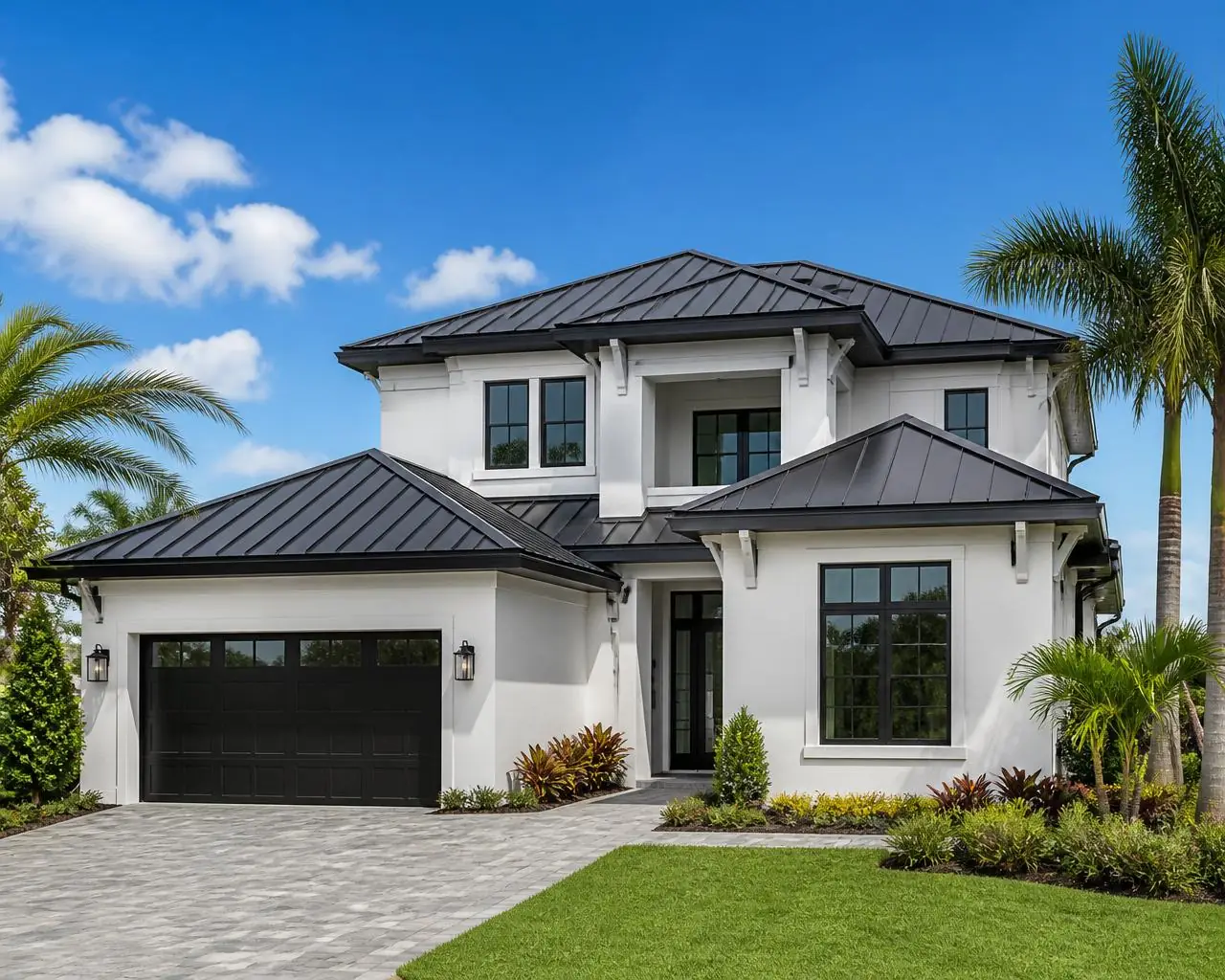
Torn Between Metal and Shingle?
We install both — so we have no reason to push you either way. Get a free inspection and a side-by-side quote for your actual roof, in writing.
Which handles hurricanes better?
This question is not theoretical in Volusia County. According to the National Hurricane Center, Florida is struck by more hurricanes than any other state — and locally we felt Ian and Nicole in 2022 and Milton's crossing of Central Florida in October 2024. FEMA building-science guidance consistently identifies the roof covering as one of the first failure points in high wind.
Both materials can be engineered for the fight. Premium architectural shingles carry ASTM D7158 Class H ratings (winds up to 150 mph), and metal panel systems are tested for high wind uplift, with metal's interlocked or clip-fastened panels generally regarded as the stronger performer in extreme wind. Either way, the Florida Building Code requires the whole assembly — deck nailing, underlayment, edge metal — to meet design wind speeds that run roughly 130 to 140 mph across much of Volusia County.
The honest takeaway from 15+ years of storm work: installation quality decides more hurricane outcomes than material choice. A code-perfect shingle roof beats a sloppy metal roof every time. If a past storm already got to your roof, our storm damage and insurance claim service can document it properly.
Which saves more on insurance and energy?
On insurance, the bigger driver is the wind mitigation report, not the covering itself. Florida Statute 627.0629 requires insurers to credit wind-resistant features — deck attachment, roof-to-wall connections, secondary water resistance — documented on form OIR-B1-1802. Any new roof built to today's code usually scores well; see our full wind mitigation inspection guide for how the credits work.
On energy, metal has a real edge in a state where air conditioning runs most of the year. ENERGY STAR materials guidance notes that reflective roofing lowers roof surface temperature and reduces the cooling load a home's AC has to fight. Reflective and “cool color” metal finishes are commonly cited as trimming cooling costs meaningfully in hot climates; dark asphalt shingles, by contrast, absorb and hold heat into the evening.
Which is right for your Volusia County home?
There is no universal winner — there is a right answer for your house, budget, and timeline:
- Choose shingles if the budget is tight, you may sell within about a decade, or you want the classic look at the lowest entry price — see our shingle roofing service.
- Choose metal if this is your long-term home, you want to buy your last roof once, or you live near the coast where wind and heat punish shingles hardest — see our metal roofing service.
- Either way, insist on a licensed contractor, a permit, and an itemized quote — in DeLand, Ormond Beach, or anywhere in between.
How do you get a real side-by-side quote?
Generic comparisons only go so far — pitch, decking, and geometry change both numbers. Heritage Roofing & Repairs (Florida license CCC1333379, serving Volusia County since 2010) installs both systems, so our free roof inspection ends with two honest, written prices for the same roof and a straight recommendation. Not sure your roof even needs attention yet? Start with our free roof self-check tool.
Cost and savings figures reflect typical Central Florida projects in 2026 and are general guidance, not a quote or a warranty of performance. Insurance topics are general information only — not insurance, legal, or financial advice.